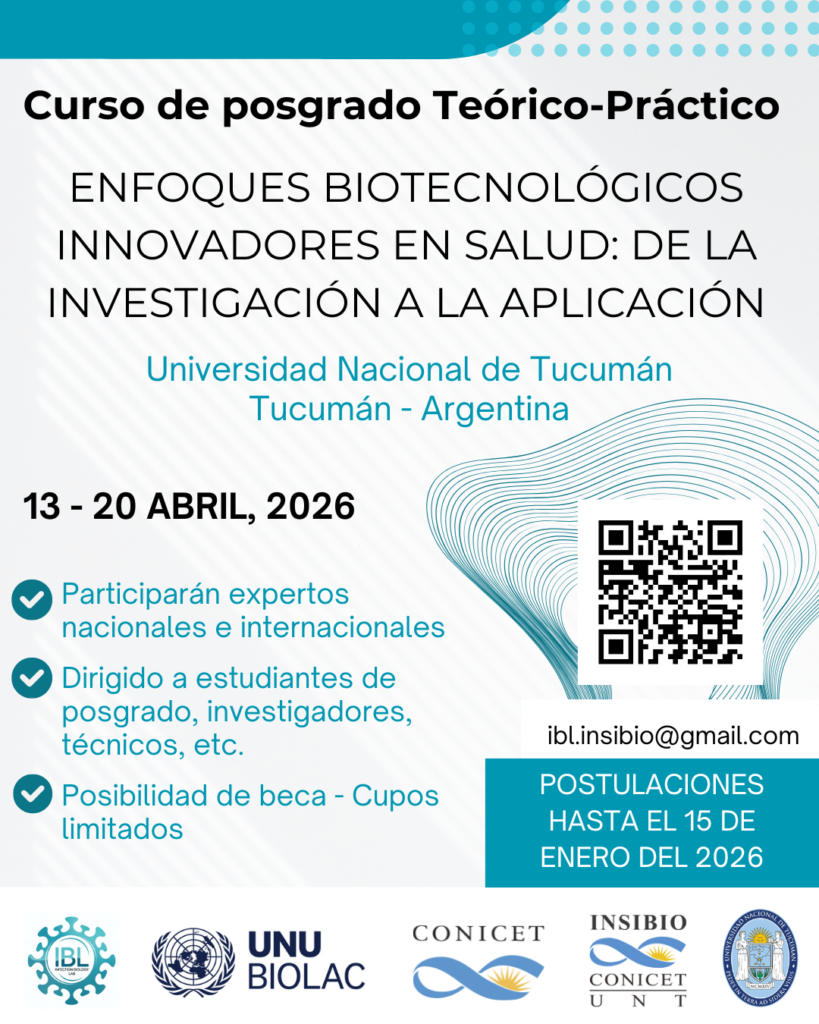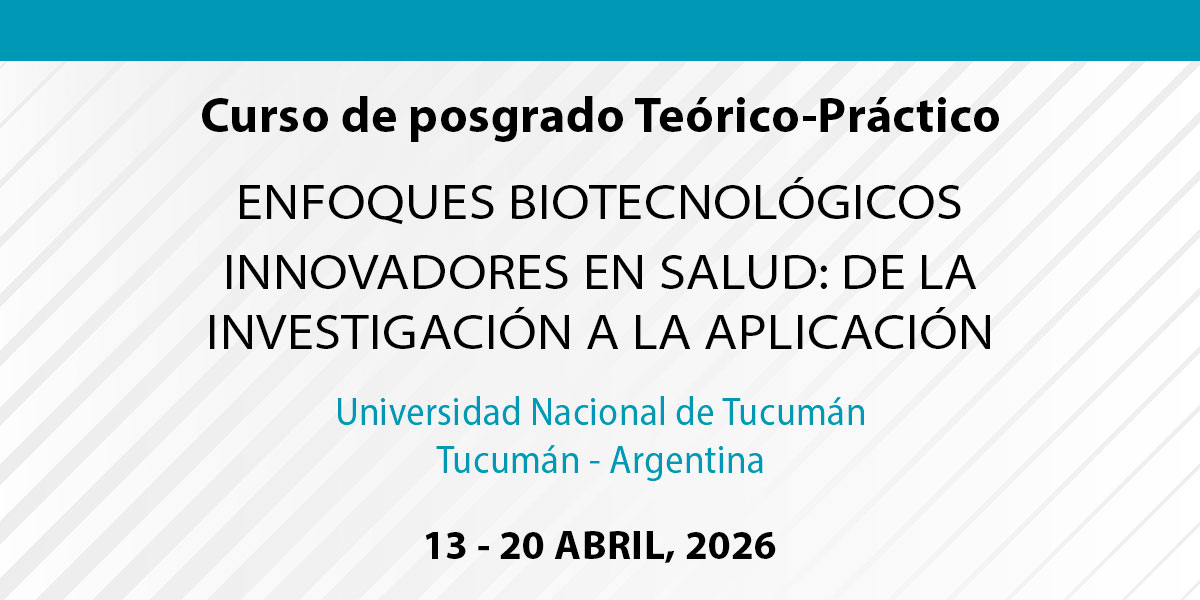
INNOVATIVE BIOTECHNOLOGICAL APPROACHES IN HEALTH - FROM RESEARCH TO APPLICATION (International Post-graduate Course, UNU-BIOLAC)
El curso tiene como objetivo capacitar a los participantes en el uso de enfoques biotecnológicos modernos para el estudio, diagnóstico, prevención y tratamiento de enfermedades infecciosas. A través de una propuesta que integra conceptos teóricos con actividades prácticas, el curso busca fortalecer las competencias necesarias para la investigación traslacional y promover la innovación científica en América Latina y el Caribe.
Directora: Dra. Ma. Guadalupe Vizoso Pinto
Docentes: de Argentina (Tucumán, La Plata, Salta), Uruguay, Japón, Portugal e Irlanda.
FECHAS: del 13 al 20 de Abril de 2026, Examen el 26 de abril.
Del 13 al 17 de abril presencial, el 20 y 26 de abril actividades virtuales.
Lugar: Laboratorio del Grupo Biología de las Infecciones, INSIBIO (CONICET-UNT), San Miguel de Tucumán, Argentina.
🎓 ¿Querés ser parte de nuestro curso?
Buscamos participantes súper motivados y con una sólida formación científica. Estos son los criterios de selección para las becas completas:
✨ Formación académica: Estudiantes avanzados de doctorado o profesionales en biotecnología, biología molecular o áreas afines. Investigadores y docentes-investigadores jóvenes también pueden postularse.
🧪 Experiencia en investigación: Participación en proyectos, publicaciones o congresos vinculados a alguna de las temáticas del curso.
💬 Carta de motivación: Queremos conocer tu interés real, cómo el curso impulsa tu carrera y su impacto en tu institución o comunidad.
🌍 Inglés: El curso es en este idioma, por lo que necesitás manejarlo bien.
🤝 Diversidad: Buscamos una cohorte diversa de toda Latinoamérica y el Caribe, con equilibrio de género.
Te invitamos a completar el formulario de interés y aplicación a las becas para acceder a más detalles sobre esta propuesta. https://forms.gle/f2EcDNsiGpWDFoLp6.
Hay disponibilidad de 12 becas completas (inscripción, traslado, alojamiento y comidas).
Si tenés alguna duda o necesitás más información, podés escribirnos a: ibl.insibio@gmail.com.
Target audience
The course is intended for PhD students, postdoctoral fellows, advanced graduate students, and early-career scientists from the Latin America and Caribbean (LAC) region working in biotechnology, molecular biology, microbiology, virology, probiotics, vaccinology and related disciplines. The target audience should have a basic understanding of molecular biology techniques and a strong interest in applying biotechnology to diagnostic, prevention and therapy of infectious diseases in human and/or animals considering the one health perspective.
Objectives of the training activity
- To train professionals in advanced biotechnology techniques applied to human and animal health with especial focus in infectious diseases.
- To foster a critical understanding of new biotechnological tools and their application in clinical and research contexts.
- To gain hands-on experience in: expression, purification and assessment of recombinant proteins and nanobodies.
- ELISA set-up (indirect, sandwich, competitive) and validation.
- In vitro assays to assess antimicrobial, phage and probiotic effects on biofilm.
- elegans as an in vivo model of infection to assess antimicrobial, phage and probiotic effects.
- To get insights on the process of biotechnology transfer. To envision how their scientific work can move beyond the laboratory and make a meaningful difference in people’s lives, emphasizing the vital role of technology transfer, collaboration, and entrepreneurial mindset in the biotech sector.
Activity Description (present a summary of content)
This intensive course offers a comprehensive exploration of cutting-edge biotechnological strategies addressing infectious diseases, encompassing diagnostics, prevention, and therapeutic interventions. Designed for postgraduate students and early-career researchers, the program integrates theoretical knowledge with practical applications, fostering skills essential for translational research and innovation in the Latin American and Caribbean (LAC) context.
Module I: Advanced Diagnostics and Surveillance
- Foundations in Health Biotechnology: An introductory session contextualizing biotechnology’s role in health, emphasizing its impact on disease management and public health. Lecture.
- Recombinant Protein Technologies: Hands-on training in classical and recombinant cloning techniques for producing antigens, laying the groundwork for serological assay development. Lectures and WET-Lab
- Nanobody Applications: Exploration of nanobodies as versatile tools in diagnostics and therapeutics, including their properties, modifications, and realworld applications. Lectures and WET-Lab
- Biosensor Development: Case study analysis of GISENS, a biotech startup, illustrating the journey from laboratory research to market-ready biosensors, highlighting technology transfer processes. Lecture.
- One Health Surveillance: Examination of hepatitis E virus as a model for zoonotic disease surveillance, discussing diagnostic tool development and crossspecies transmission monitoring. Lectures and WET-Lab.
- Wastewater-Based Epidemiology (WBE): Introduction to WBE as a method for community-level pathogen surveillance, including discussions on metagenomics and targeted next-generation sequencing (tNGS) techniques for comprehensive pathogen detection. Lecture.
Module II: Preventive Strategies and Host-Microbe Interactions
- Mucosal Vaccine Innovations: Comparative analysis of mucosal versus parenteral vaccines, evaluating the efficacy and safety profiles of attenuated and subunit vaccine platforms. Lectures.
- Probiotics and Immunobiotics: Investigation into the role of probiotics in modulating immunity, gut microbiota, and their implications in obesity and infection control. Lectures.
- Microfluidic Co-Culture Systems: Utilization of microfluidic devices to assess the impact of live and inactivated lactic acid bacteria on swine intestinal epithelial cells, facilitating the selection of strains with potential as vaccine adjuvants.
- In Vivo Modeling: Application of murine models for evaluating novel vaccines and the use of Caenorhabditis elegans to study innate immunity and infection dynamics, including protocols for synchronization, survival analysis, colonyforming unit (CFU) enumeration, and microscopy. Lectures and WET-Lab
Module III: Therapeutic Innovations and Antimicrobial Strategies
- Addressing Antimicrobial Resistance (AMR): Overview of the global AMR crisis, exploring innovative solutions such as phage therapy, bacteriocins, and engineered antimicrobials. Design of new antimicrobial therapies that consider interactions. Use of bacteria as biocontrol (e.g., Bacillus spp. or Lactobacillus as
- Biotechnology Programme for Latin America and the Caribbean. Programa de Biotecnología para América Latina y el Caribe UNU UNCLASSIFIED producers of active compounds). Development of anti-biofilm medical devices. Diagnostic potential: coexistence patterns that predict clinical outcome. Lectures and WET-Lab.
- Synthetic Microbiome Models: Discussion on the development of simplified gut microbiome communities (e.g., SIHUMI model) to study pathogen interactions and antimicrobial interventions in controlled settings.
- Phage Therapy Applications: Evaluation of phage cocktails against planktonic bacteria and biofilms through in vitro assays and validation using C. elegans infection models. Lectures and WET-Lab
- Translational Research and Entrepreneurship: Insights into bridging academic research with societal needs, featuring case studies of biotech startups like Untech, emphasizing the transition from bench to bedside. Lecture.